Abstract
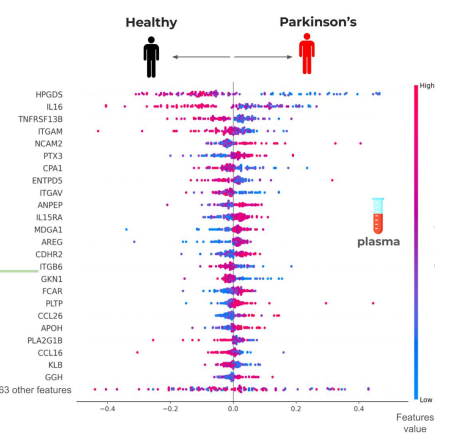
Cognitive decline is a major source of disability in Parkinson’s disease (PD), yet reliable prognostic biomarkers are still lacking. In this observational study, we analyzed longitudinal plasma proteomics from the Parkinson’s Progression Markers Initiative (PPMI; 199 samples from 68 PD patients and 345 samples from 115 healthy controls; Olink®). We sought to validate our findings cross-sectionally in the Parkinson’s Disease Biomarkers Program (PDBP; 175 PD and 17 HC; SomaScan®). Of the modules with proteins measured on both platforms, the associations for three lysosomal proteins (CTSD, CTSZ, CST3) replicated. We identified 284 proteins distinguishing PD from controls (AUC = 0.88); 63 grouped into five co-expression modules associated with cognition, four of which correlated with regional brain atrophy in at least one analysis. Elevated plasma Cathepsin D (CTSD), Cathepsin Z (CTSZ), and Cystatin C (CST3) levels were linked to both cognitive and motor impairment. In an exploratory analysis, a combined clinical–proteomic model showed preliminary predictive ability to forecast future cognitive decline in a held-out subset of PD participants (R² = 0.365). These findings define a plasma signature of cognitive vulnerability in PD and suggest lysosomal protease dysfunction as a potential contributor.
View Full Article: https://www.nature.com/articles/s41531-026-01612-4