Background
A prior study using the Parkinson’s Progression Markers Initiative (PPMI) dataset developed a machine learning (ML) model to classify Parkinson’s disease (PD) patients as slower or faster progressors based on the 48 month change in OFF medication MDS UPDRS III scores, calculated as the difference between baseline and 48 month values. Using baseline MRI-derived multivariate gray matter volume (MGMV), age, sex, and MDS-UPDRS-III scores as features, the model achieved 89% accuracy. Evaluating its performance in independent clinical cohorts is essential to assess generalizability and clinical utility.
Methods
This validation study used data from the Parkinson’s Disease Biomarkers Program (PDBP). Sixteen PD patients with baseline T1 weighted MRI, baseline MDS UPDRS III scores, and longitudinal follow up of up to 36 months were included. Due to the absence of 48 month follow up, progression status was defined using the longitudinal slope of MDS UPDRS III scores. The previously trained PPMI derived ML classifier was applied using age, sex, baseline MDS UPDRS III scores, and MGMV. Model performance was evaluated using sensitivity, specificity, and balanced accuracy.
Results
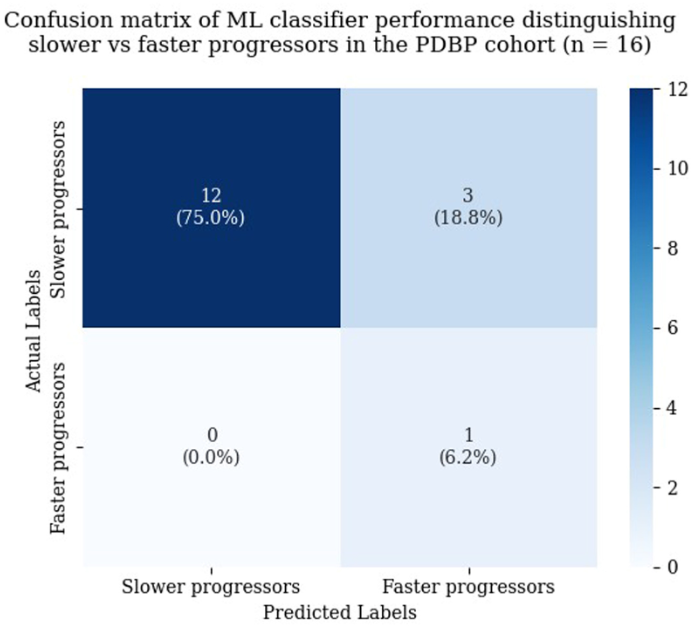
The PDBP cohort had a mean age of 65.75 ± 10.77 years, was predominantly male (68.7%), and had a mean baseline MDS UPDRS III score of 21.18 ± 13.95. Among the 16 participants, one was identified as a fast progressor and fifteen as slow progressors. The model correctly identified the fast progressor with a sensitivity of 100% (1/1) and achieved a specificity of 80% (12/15) for slow progressors, resulting in a balanced accuracy of 90%.
Conclusions
The ML classifier achieved a balanced accuracy of 90% in an independent cohort, correctly identifying the single fast progressor and most slow progressors. While these findings indicate predictive capability beyond the original PPMI dataset, the small and imbalanced sample limits definitive conclusions. Validation in larger independent cohorts is necessary to establish robust generalizability.
View Full Article: https://www.prd-journal.com/article/S1353-8020(26)00385-8/fulltext