Background
This multiplex proteomic analysis using the recently released NULISA platform revealed unique targets of Lewy body dementia progression and neuropathology.
Methods
CSF samples were obtained from participants enrolled in PDBP, a large, multi-center, longitudinal, observational cohort supported by the National Institutes of Health (NIH) comprised of individuals with PD and related disorders recruited from tertiary care centers across the United States. All samples were acquired under the Institutional Review Board (IRB) protocols of their representative institutions. Our cohort contained a total of 685 CSF samples from 476 unique individuals with clinical diagnoses of controls (n=86), PD (n=178), DLB (n=185), and “Other / NA” (n=27). We also analyzed 44 pooled CSF standards provided by PDBP for use in data normalization. All cases were diagnosed based on clinical assessments by local site PIs. No imaging or other biomarker assays were required for these diagnostic determinations. Control cases were cognitively unimpaired by neuropsychological measures without any history of parkinsonism or other neurodegenerative disease. Lewy body cases were diagnosed according to established clinical criteria (1, 8). Of the 476 unique cases, there were 259 with CSF only at baseline enrollment, 13 with CSF only at 24-month follow up, and 204 with CSF at both baseline and 24 months (Tables S1-S2).
Results
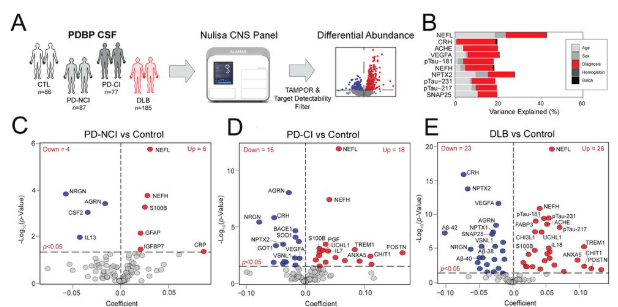
Our principal PDBP discovery cohort comprised 685 CSF samples from 476 unique individuals with clinical diagnoses of control (n=86), PD (n=178), DLB (n=185), and NA / Other (n=27). All cases were diagnosed based on clinical assessments by local site PIs. No imaging or biomarker assays were required for diagnostic determinations. Controls were cognitively unimpaired by neuropsychological measures without any history of parkinsonism or other neurodegenerative disease. Lewy body cases were diagnosed according to established clinical criteria (1, 8). CSF samples were donated at baseline and/or 24-month study visits.
Conclusions
Overall, our results highlight the utility of multiplex proteomic analysis in the identification of CSF signatures of cognitive and neuropathological heterogeneity in LBD. These findings also underscore the molecular complexity of LBD, the influence of co-pathology on biomarker results, and the importance of neuropathological context in the interpretation of emerging biomarkers across the LBD-AD spectrum. Future directions include deeper multi-cohort proteomic analyses across the CSF and plasma of these clinical and neuropathological LBD subgroups to further bolster these NULISA findings and enhance the precision of emerging multiplexed biomarker tools for this condition.
View Full Article: https://www.biorxiv.org/content/10.1101/2025.06.10.658994v2.full#sec-28